
THE DAY WHEN INTERNATIONAL AND HUMAN RIGHTS WERE VIOLATED
Some media spoke of us as evil Serbs who deserved a lesson in the form of military intervention, that we were savages and that we were terrorising Albanians in the territory of the Serbian province of Kosovo and Metohija. Some of us did not believe it would happen. We thought it
was just propaganda—there had been wars and pressures before, but since we were in Europe, a non-aligned, neutral country, and it was the 20th century, whom had we harmed? And then the FRY was attacked on the pretext that it was responsible for the failure of negotiations in Rambouillet and Paris on the future status of the province of Kosovo and Metohija.
In Waging Modern War, General Wesley Clark noted that by midJune 1998, NATO’s planning regarding the Federal Republic of Yugoslavia (FRY) was already well underway. During this same period, U.S. and European Union leaders accused Serbian forces of ethnic cleansing, war crimes, and creating a humanitarian catastrophe in Kosovo. For the first time in history, NATO decided to launch an air campaign without authorisation from the United Nations Security Council. The order was issued by NATO Secretary General Javier Solana to the Supreme Allied Commander Europe, U.S. General Wesley Clark. Solana stated that the operation’s objective was to halt the humanitarian disaster unfolding in Kosovo.
According to a statement by the General Staff of the Yugoslav Army, the first NATO air strikes on March 24, 1999, targeted more than 20 sites across the Federal Republic of Yugoslavia. At 19:53, the first missiles struck the Ratko Pavlović–Ćićko barracks and its communications centre in Prokuplje. In that attack, soldier Boban Nedeljković was killed—considered the first casualty of the NATO campaign—and five other soldiers were wounded.
Following the initial strikes, NATO attacks continued against targets in Priština, Kuršumlija, Batajnica, and Straževica. At the same time, transmitters and communication systems on Jastrebac and other locations were hit, including additional strikes on Straževica in Rakovica. Danilovgrad was also bombed, where soldier Saša Stojić from Belgrade was killed, and the Golubovci airport near Podgorica sustained damage.
According to data from the Ministry of Defence of Serbia, NATO’s air campaign resulted in the deaths of 1,031 members of the Yugoslav Army and police. Civilian casualties were estimated at around 2,500, including 89 children. Approximately 6,000 civilians were wounded—among them 2,700 children—alongside 5,173 soldiers and police officers. In addition, 25 persons remain listed as missing.
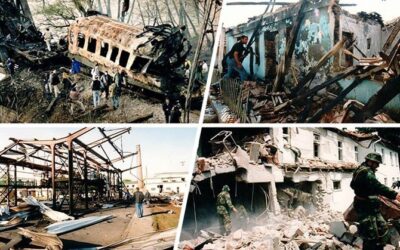
During the bombing campaign, widespread damage was inflicted across the Federal Republic of Yugoslavia: 25,000 residential buildings were destroyed or damaged, 470 kilometers of roads and 595 kilometers of railways were hit, and fourteen airports, nineteen hospitals, twenty health centers, eighteen kindergartens, sixtynine schools, 176 cultural monuments, and fortyfour bridges were damaged—thirtyeight of them completely destroyed.
Amid this escalating destruction, one of the most notorious incidents occurred on the night of April 23, 1999. At 2:06 a.m., NATO missiles struck the headquarters of Radio Television of Serbia (RTS) in Belgrade, killing sixteen employees. This marked the first time in modern conflict that a media house was declared a legitimate military target.
The building of Novi Sad Television was destroyed on May 3, International Press Freedom Day.
The expression “collateral damage,” used by NATO representatives, was often heard during those 78 days of bombing, while civilians were dying—Albanians, Serbs, or others.
On May 1, 1999, NATO bombed the bridge in Lužane near Podujevo, as a NišEkspres bus was crossing, killing 44 people. Two days later, the target was a “Đakovica Transport” bus near Savina Voda, on the Peć–Kula–Rožaje road—20 people were killed, and 43 were injured.
Near the village of Koriša, not far from Prizren, on May 14, a column of people was bombed—87 were killed and 70 wounded. The Dubrava prison in Istok was hit on May 21, killing at least 20 inmates.
On Easter Monday, at 11:39 a.m., NATO aircraft struck a passenger train crossing the bridge over the South Morava, killing an undetermined number of civilians. At the site of the tragedy, a message was later inscribed: “One should not fear people, but the inhumanity within them!” A video recording of both missile strikes on the train can be found at the link https://rt.rs/…/26835-grdelicka-klisura-godisnjica-voz…/.
Banned cluster bombs were dropped on the civilian population of Niš, causing significantcasualties and drawing widespread condemnation.
Shortly afterwards, on May 7, 1999, three NATO missiles struck the Embassy of the People’s Republic of China in New Belgrade, killing three Chinese journalists and wounding about twenty others. NATO expressed regret for the incident, attributing it to outdated maps and a coordinate error.
Beyond the immediate destruction, the longterm consequences of the bombing campaign also became evident. According to international experts, in the 26 years since the conflict, more than 40,000 people have died from illnesses linked to exposure to depleted uranium munitions.
The war formally ended on June 10, 1999, when the UN Security Council adopted Resolution 1244. Following this, 37,200 KFOR soldiers from 36 countries were deployed to Kosovo with the mandate of maintaining peace and security. However, the arrival of KFOR forces coincided with a mass exodus: approximately 230,000 Serbs and Roma left Kosovo and Metohija, marking a profound demographic shift in the province.
“WHEN THE ARMY RETURNS TO KOSOVO”
Sabor Movement
Media Team, Snežana Avramović
Belgrade, March 24, 2026